




AUD slides as Australian unemployment rate jumps in April
The Australian dollar weakened after a surprise jump in the unemployment rate to 4.2% in April, raising expectations of a rate cut by the Reserve Bank of Australia.
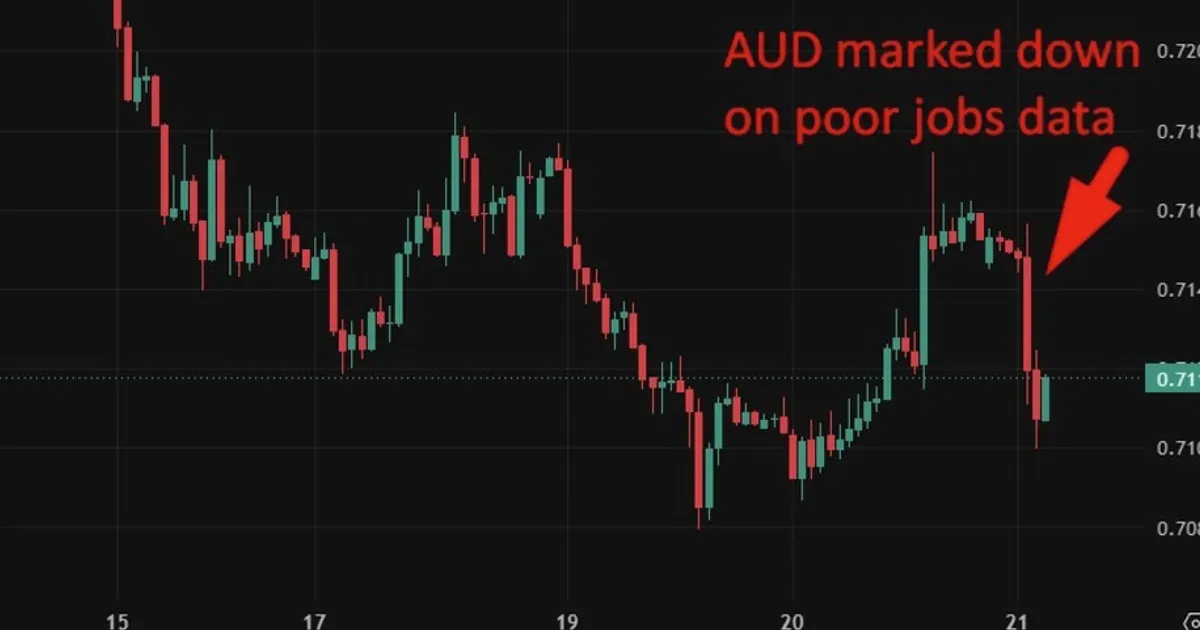
The Australian dollar fell sharply on Thursday after official data showed the unemployment rate unexpectedly rose to 4.2% in April, its highest level in over a year. The jump in joblessness comes despite a solid increase in employment, as the participation rate also climbed, signaling slack in the labor market. The AUD/USD pair dropped over 0.5% to trade near 0.6550, extending its recent decline as markets reassess the interest-rate differential between Australia and the United States. The Australian dollar's weakness was compounded by a broader risk-off mood, with commodity prices slipping and global growth concerns weighing on the currency.
The data reinforces the case for the Reserve Bank of Australia to begin easing policy sooner than previously anticipated. Markets now price in a higher probability of a rate cut as early as the August meeting. For currency traders, the weaker AUD reflects a shift in interest-rate differentials, with Australian bond yields falling relative to US Treasuries. This divergence is a classic example of uncovered interest rate parity in action: as the expected return on Australian assets declines, capital flows shift toward higher-yielding US dollar-denominated instruments, putting downward pressure on the AUD. The move also weighed on the New Zealand dollar, as the two currencies often trade in tandem due to their similar exposure to commodity exports and China demand. Traders can monitor the latest AUD/USD and NZD/USD quotes on NowPrice for real-time levels. The real-rate differential, which accounts for inflation expectations, has also turned against the Australian dollar, as US real yields remain elevated while Australian real yields decline.
Looking ahead, attention will turn to the RBA's next policy decision and any forward guidance from Governor Bullock. The Australian dollar may remain under pressure if further labor market weakness emerges, potentially triggering a carry-trade unwind as investors reduce exposure to high-yielding currencies. Key support for AUD/USD lies near the 0.6500 level, which represents a psychological barrier and a prior intervention threshold for the RBA. Resistance is seen around 0.6600, where the 50-day moving average converges. A break below support could open the door to a test of the 0.6400 area, especially if the terms of trade deteriorate further due to falling iron ore and coal prices. Traders should also watch for any verbal intervention from RBA officials, as a rapidly weakening currency could stoke imported inflation and complicate the central bank's policy path.