




Vanguard Stays Bullish on Treasuries as 10-Year Yields Near Range Top
Vanguard Group Inc. reaffirms its bullish stance on US Treasuries, signaling that 10-year yields near the top of the expected range present a buying opportunity for fixed-income investors.
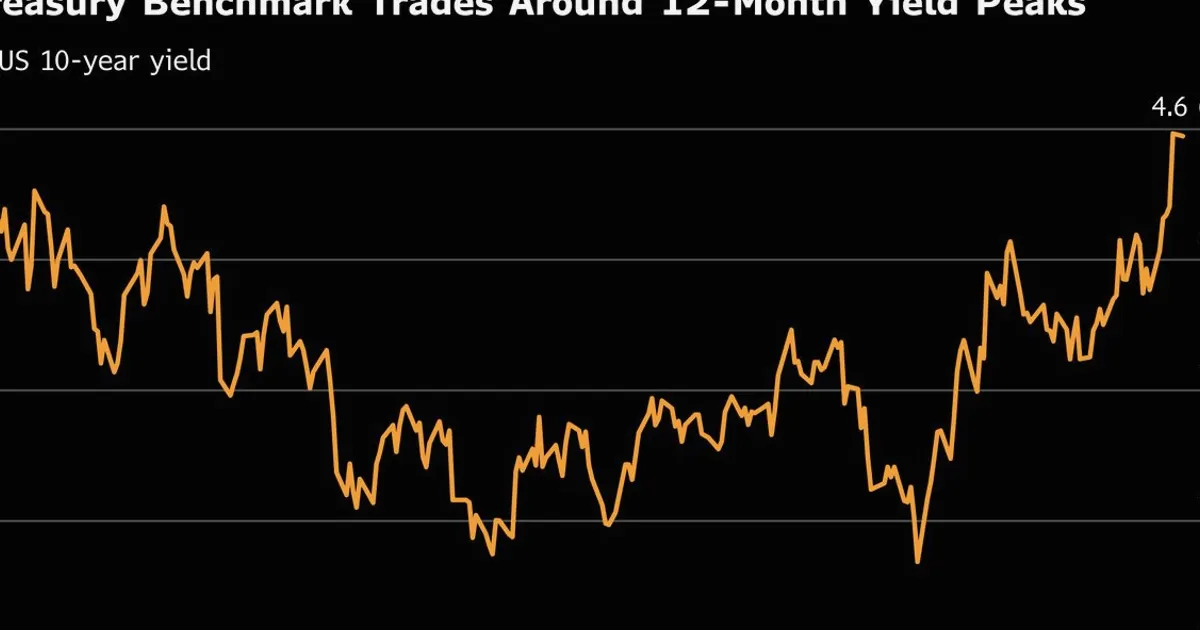
Vanguard Group Inc., one of the world's largest money managers, is sticking with its bet on US Treasuries, saying yields in the $31 trillion market are near the top of its expected range for 10-year notes. The firm's fixed-income team sees current yield levels as attractive for long-term investors, given the macroeconomic backdrop and the Federal Reserve's policy trajectory. The 10-year yield, currently around 4.5%, sits near the upper bound of Vanguard's estimated range, which spans roughly 4.25% to 4.75%. This view aligns with the so-called Fed model, which compares earnings yield on equities (the inverse of the forward P/E) to Treasury yields. With the S&P 500 forward P/E near 20x, the earnings yield is about 5%, only modestly above the 10-year yield, suggesting stocks are not cheap relative to bonds. Vanguard's preference for Treasuries implies that the risk premium for equities is thin, and any further rise in yields could tip the balance in favor of fixed income.
The decision to favor Treasuries comes amid a period of elevated volatility in bond markets, with the 10-year yield oscillating within a well-defined range. For equity traders, this signals a potential shift in risk sentiment: if yields break above the range top, it could pressure growth stocks by raising the discount rate on future cash flows, particularly in high-valuation sectors like technology. Conversely, a pullback in yields might support a rotation into rate-sensitive sectors such as utilities and real estate. Breadth indicators, such as the percentage of S&P 500 stocks above their 50-day moving average, have weakened recently, reflecting caution. Additionally, buyback yields, which have been a key support for equities, may become less attractive if bond yields remain elevated, as companies could opt to reduce debt instead. Options-implied volatility, as measured by the VIX, remains elevated near 20, suggesting traders are pricing in uncertainty around the yield trajectory. Live stock prices and charts on NowPrice show how the market is reacting to these bond market dynamics in real time.
Looking ahead, investors will watch for the next Fed meeting and key inflation data, which could either validate Vanguard's view or trigger a breakout. A higher-than-expected CPI print could push yields above the range top, potentially sparking a selloff in equities, especially growth stocks. Conversely, a dovish Fed or softer inflation could drive yields lower, supporting a rotation into rate-sensitive sectors. The 10-year yield's behavior at the range boundary will be a critical signal for both fixed-income and equity markets in the coming weeks. For now, Vanguard's stance reinforces the narrative that bonds offer a compelling alternative to stocks, particularly if economic growth slows and the Fed maintains a cautious stance.