




Hungary Yields Near UK Gilts as Pro-EU Shift Drives Bond Rally
Hungarian bond yields have fallen to levels near UK gilts as investor confidence surges on the new government's pro-European Union economic agenda.
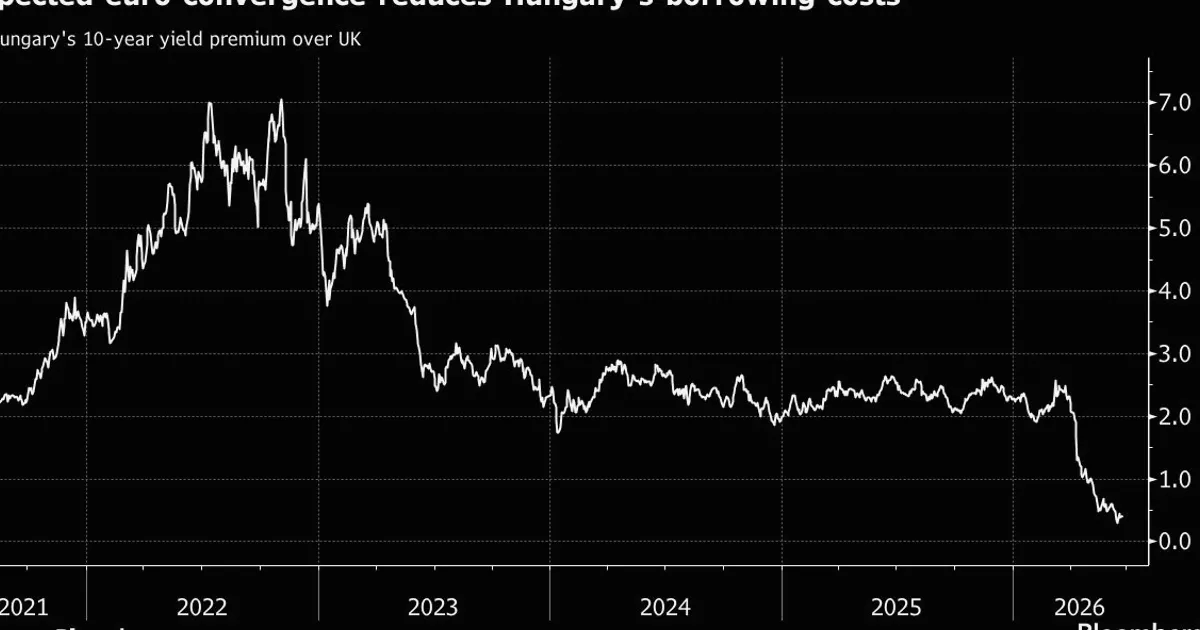
Hungarian government bond yields have converged sharply toward UK gilt levels, a dramatic shift driven by investor optimism over the new administration's pro-European Union economic reforms. The rally reflects a repricing of Hungarian risk as markets bet on fiscal consolidation and a path toward eventual euro adoption. The yield on Hungary's 10-year benchmark has fallen to around 3.2%, compared with UK gilts at approximately 3.5%, narrowing the spread to just 30 basis points from over 100 basis points a year ago. This convergence is particularly notable given that UK gilts are considered a safe-haven asset, while Hungarian bonds have historically carried a significant risk premium due to political uncertainty and fiscal concerns.
For interest rate and central bank policy traders, the narrowing spread between Hungarian and UK yields signals a profound change in risk perception. Historically, Hungarian bonds carried a significant premium due to political uncertainty and fiscal concerns. The current compression suggests markets are pricing in lower inflation expectations and a more credible monetary policy framework under the new government. The Federal Reserve's dual mandate of maximum employment and price stability often influences global yield dynamics, but here the focus is on the European Central Bank's transmission protection mechanism, which shields euro-area members from unwarranted spread widening. For Hungary, the pro-EU turn reduces the risk of policy divergence, making its bonds more attractive relative to UK gilts. Traders can track real-time yield movements on NowPrice to monitor this convergence, as well as key indicators like yield-curve inversion and term-premium decomposition, which provide deeper insights into market expectations.
Looking ahead, key events to watch include the Hungarian central bank's next policy decision, where any rate cuts would test the sustainability of the rally. Also critical are EU fund disbursements, which could further tighten spreads if they materialize. The European Commission has frozen billions in cohesion funds due to rule-of-law concerns, but the new government's reforms could unlock these resources, boosting Hungary's fiscal position. Any setback in reform implementation or geopolitical tensions could quickly reverse the trend, making Hungarian bonds a high-beta play on European integration sentiment. Traders should also monitor swap spreads and balance-sheet impacts from the ECB, as these can affect relative value across European bond markets. The convergence trade remains vulnerable to shifts in global risk appetite, but for now, Hungary's pro-EU pivot has fundamentally altered its risk profile.