




Fed Decision Expected Unanimous, JPMorgan Manager Says
JPMorgan Asset Management expects no dissenting votes at this week's Federal Reserve interest rate decision, with bond market focus shifting to the US-Iran agreement.
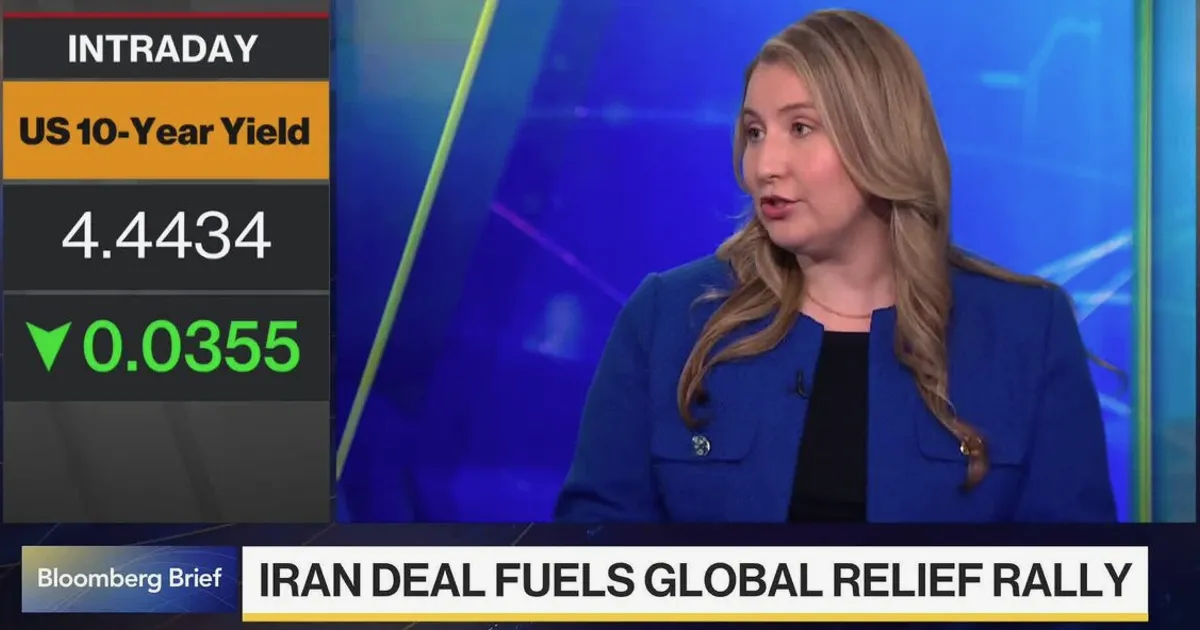
JPMorgan Asset Management expects this week's Federal Reserve interest rate decision to pass without any dissenting votes, according to fixed income portfolio manager Kelsey Berro. A unanimous vote would reinforce the perception of a cohesive committee, reducing uncertainty around the near-term rate path. In the context of the Fed model—which compares earnings yield on the S&P 500 to the 10-year Treasury yield—the current earnings yield stands at roughly 5.3% (based on a forward P/E of 18.9x) versus a 10-year yield near 4.5%, suggesting equities remain relatively attractive versus bonds, though the gap has narrowed. The absence of dissent would signal policy continuity, which typically supports risk assets by keeping implied volatility (as measured by the VIX) in check. However, the bond market has also been reacting to the announcement of an agreement between the US and Iran, which could influence oil prices and inflation expectations. Berro noted that the Fed is likely to maintain its current stance, with no committee members breaking ranks. For equity traders, a unanimous decision would signal policy continuity, reducing uncertainty around rate paths. However, the broader macro backdrop, including geopolitical developments, remains a key driver of risk sentiment. Traders can check NowPrice's stocks page for real-time pricing on sectors sensitive to interest rates and oil, such as financials, energy, and utilities. Breadth indicators, such as the percentage of S&P 500 stocks above their 50-day moving average, have been mixed, while sector rotation has favored defensive groups amid geopolitical risks. Buyback yields, which have been a key support for equities, remain elevated at around 3.5% for the S&P 500, providing a floor under prices.
Looking ahead, market participants will focus on the Fed's statement and any forward guidance for clues on future moves. Key data releases, such as inflation and employment figures, will also shape expectations. The US-Iran agreement's implementation and its impact on energy markets will be closely watched. Options-implied volatility on oil-related equities has risen, reflecting uncertainty around supply dynamics. A unanimous Fed decision could help calm near-term volatility, but the broader macro landscape—including geopolitical tensions and data dependency—will dictate the next leg for stocks. The forward P/E for the S&P 500 has compressed from 21x earlier this year to 18.9x, but further compression could occur if bond yields rise or earnings estimates are revised down. Sector rotation may accelerate if the Fed signals a prolonged hold, benefiting rate-sensitive sectors like real estate and utilities, while growth stocks could face headwinds from elevated discount rates. The interplay between Fed policy, oil prices, and corporate earnings will be critical for determining whether the current equity risk premium remains sufficient to attract investors.